Next-Generation SDR Framework Moves Beyond Hardware Limitations as Third-Year Robotics Platform Project Kicks Off
The Era of Software Defined Robots Begins as Industry, Academia, and Research Institutions Prepare for an Integrated Demonstration Later This Year
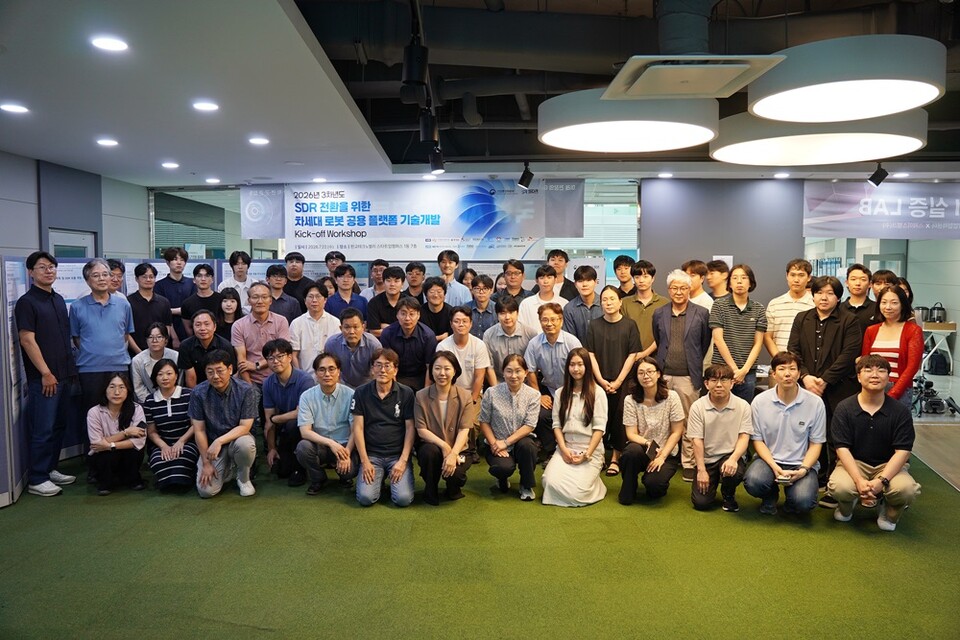
▲ The third-year kickoff workshop for the “Development of a Next-Generation Common Robotics Platform for the Transition to Software Defined Robots (SDR).” | Photo by AVING News
The third-year kickoff workshop for the “Development of a Next-Generation Common Robotics Platform for the Transition to Software Defined Robots (SDR)” was successfully held on July 22 at the Gyeonggi Startup Campus in Pangyo Techno Valley.
Hosted by the Humanoid Research Group at the Korea Institute of Science and Technology (KIST), the event was organized to share third-year R&D plans for the development of a framework, common interfaces, and service operation system for cloud-based SDR common services, while further strengthening collaboration among participating organizations.
The workshop began with presentations reviewing the second-year progress and outlining third-year plans for the project's two major research areas.
For the first research area, Dr. Do-Ik Kim of KIST explained the core objective of the SDR framework: overcoming dependence on specific robot hardware and establishing a consistent software architecture.
He also introduced an innovative robot control approach using semantic information and Large Language Models (LLMs).
“When people give instructions or write commands, they tend to describe them in human-like or biological terms. If we can translate those descriptions into a form that robots can understand, we can create a generalized approach that works across different types of robots,” Dr. Kim said.
He highlighted a flexible, template-based architecture in which a command referring to an “arm,” for example, could automatically be interpreted as a “front leg” when applied to a quadruped robot.
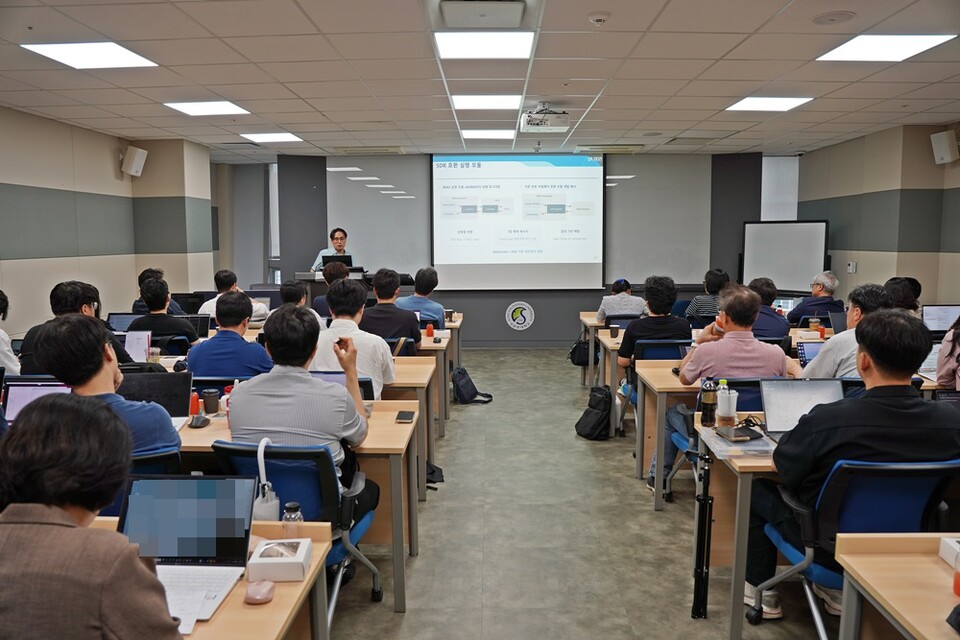
▲ The third-year kickoff workshop for the Software Defined Robot (SDR) project. | Photo by AVING News
For the second research area, Dong-Yeop Kim of the Korea Electronics Technology Institute (KETI) presented plans for applying the SDR framework and cloud platform developed in the first research area to business models across different domains.
The presentation covered achievements including elevator integration systems, robot self-calibration, and virtual-environment simulation uploads using Gazebo World.
With RoboWorld scheduled for November, Kim emphasized the need for close and rapid collaboration among participating organizations, noting that only about three months remained to port the second research area's applications to SDR ahead of the integrated demonstration later in the year.
Spacebank Demonstrates Cloud-Based OTA and Integrated Robot Management
Another major highlight of the event was the poster presentation and demonstration session, which provided a closer look at the roadmap for third-year SDR module development and its potential for real-world applications.
Spacebank showcased its cloud-based SDR platform featuring Over-the-Air (OTA) technology, a service script system, scenario simulator, and robot monitoring and management system.
In particular, the demonstration presented what was described at the event as a world-first implementation in which a robot wirelessly downloaded modules from a marketplace via a cloud-based SDR platform and used them to perform a variety of tasks.
Spacebank also demonstrated a platform capable of integrating and managing multiple heterogeneous robots through a single interface, drawing significant attention from participants.
This approach demonstrates how robot capabilities can move beyond fixed hardware configurations and continuously evolve through software modules delivered via the cloud.
AI-Based Robot Manipulation, Humanoids and Integrated Monitoring
The Electronics and Telecommunications Research Institute (ETRI) presented its research plan for developing AI-based robot manipulation software modules capable of handling diverse backgrounds and previously unseen objects.
The modules are being developed as Docker-based containers, with the goal of enabling real-time pick-and-place operations through teleoperation and autonomous manipulation.
In the security and inspection sector, collaboration between ROBROS and Rastech attracted attention.
ROBROS presented a business model in which a Wi-Fi IP camera is mounted on the back of the hand of its bipedal humanoid robot, IGRIS-C, enabling patrol video from indoor facilities to be transmitted to a monitoring system.
Rastech introduced a cloud-based integrated monitoring and management system capable of connecting and managing video data from humanoids and multiple robots.
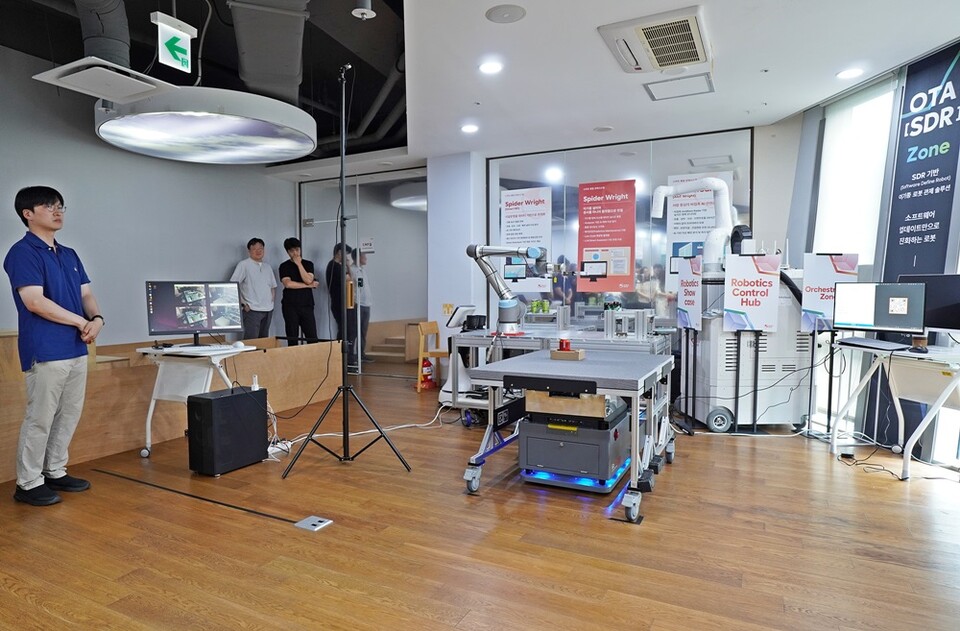
▲ The third-year kickoff workshop for the Software Defined Robot (SDR) project. | Photo by AVING News
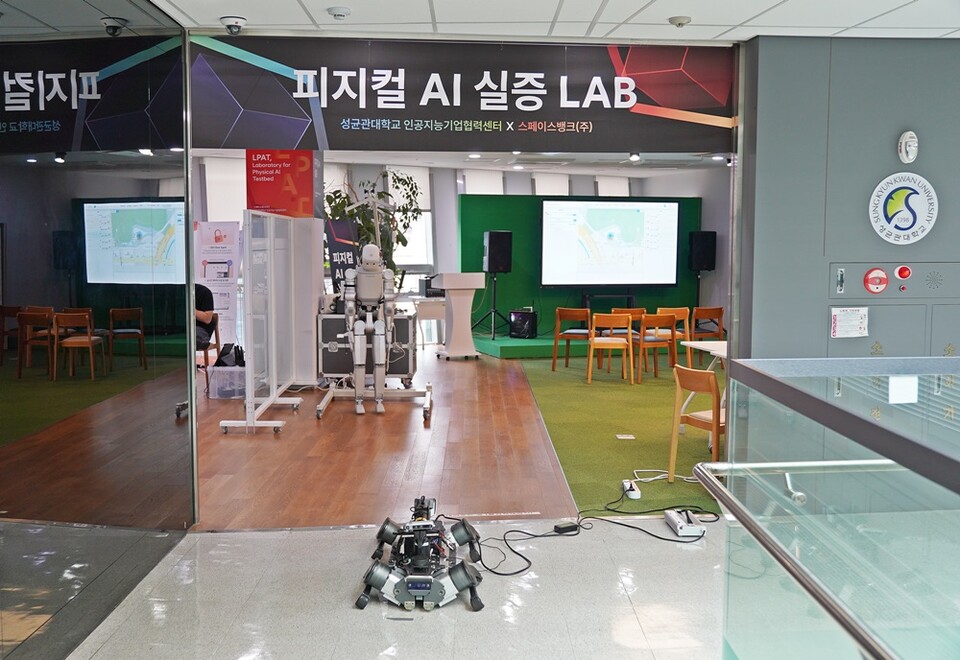
▲ The third-year kickoff workshop for the Software Defined Robot (SDR) project. | Photo by AVING News
SDR Expands Across Logistics, F&B, Security and Healthcare
Yujin Robot presented plans to develop a Fleet Management System (FMS) for multi-robot and heterogeneous robot configurations.
The company plans to demonstrate manufacturing logistics and hospital logistics business models by applying SDR-based OTA scenarios and self-calibration technologies.
CDR System presented plans to establish a food and beverage (F&B) café testbed combining collaborative robots and mobile robots, as well as a Robot Management System (RMS) connecting the hardware system with an ordering and payment server.
Hanyang University also presented its work on advancing markerless self-calibration algorithms.
Toward Robots That Continuously Evolve Through Software
The third-year kickoff workshop demonstrated the potential for robots across a wide range of industries—including logistics, F&B, security and surveillance, and humanoids—to continuously evolve their capabilities through SDR-based platforms and OTA technology.
Rather than remaining limited by fixed hardware capabilities, robots can gain new functions through software modules and adapt to different business requirements and operational environments.
With exhibitions planned later this year and an integrated demonstration scheduled for December, participating companies, universities, and research institutions are accelerating their collaboration toward the next stage of the SDR project.
The initiative represents an important step toward a software-driven robotics ecosystem, where cloud-based platforms, OTA technology, AI, and robotics converge to enable robots to become more flexible, scalable, and continuously upgradable.
https://kr.aving.net/news/articleView.html?idxno=1812609


Next-Generation SDR Framework Moves Beyond Hardware Limitations as Third-Year Robotics Platform Project Kicks Off
The Era of Software Defined Robots Begins as Industry, Academia, and Research Institutions Prepare for an Integrated Demonstration Later This Year
▲ The third-year kickoff workshop for the “Development of a Next-Generation Common Robotics Platform for the Transition to Software Defined Robots (SDR).” | Photo by AVING News
The third-year kickoff workshop for the “Development of a Next-Generation Common Robotics Platform for the Transition to Software Defined Robots (SDR)” was successfully held on July 22 at the Gyeonggi Startup Campus in Pangyo Techno Valley.
Hosted by the Humanoid Research Group at the Korea Institute of Science and Technology (KIST), the event was organized to share third-year R&D plans for the development of a framework, common interfaces, and service operation system for cloud-based SDR common services, while further strengthening collaboration among participating organizations.
The workshop began with presentations reviewing the second-year progress and outlining third-year plans for the project's two major research areas.
For the first research area, Dr. Do-Ik Kim of KIST explained the core objective of the SDR framework: overcoming dependence on specific robot hardware and establishing a consistent software architecture.
He also introduced an innovative robot control approach using semantic information and Large Language Models (LLMs).
“When people give instructions or write commands, they tend to describe them in human-like or biological terms. If we can translate those descriptions into a form that robots can understand, we can create a generalized approach that works across different types of robots,” Dr. Kim said.
He highlighted a flexible, template-based architecture in which a command referring to an “arm,” for example, could automatically be interpreted as a “front leg” when applied to a quadruped robot.
▲ The third-year kickoff workshop for the Software Defined Robot (SDR) project. | Photo by AVING News
For the second research area, Dong-Yeop Kim of the Korea Electronics Technology Institute (KETI) presented plans for applying the SDR framework and cloud platform developed in the first research area to business models across different domains.
The presentation covered achievements including elevator integration systems, robot self-calibration, and virtual-environment simulation uploads using Gazebo World.
With RoboWorld scheduled for November, Kim emphasized the need for close and rapid collaboration among participating organizations, noting that only about three months remained to port the second research area's applications to SDR ahead of the integrated demonstration later in the year.
Spacebank Demonstrates Cloud-Based OTA and Integrated Robot Management
Another major highlight of the event was the poster presentation and demonstration session, which provided a closer look at the roadmap for third-year SDR module development and its potential for real-world applications.
Spacebank showcased its cloud-based SDR platform featuring Over-the-Air (OTA) technology, a service script system, scenario simulator, and robot monitoring and management system.
In particular, the demonstration presented what was described at the event as a world-first implementation in which a robot wirelessly downloaded modules from a marketplace via a cloud-based SDR platform and used them to perform a variety of tasks.
Spacebank also demonstrated a platform capable of integrating and managing multiple heterogeneous robots through a single interface, drawing significant attention from participants.
This approach demonstrates how robot capabilities can move beyond fixed hardware configurations and continuously evolve through software modules delivered via the cloud.
AI-Based Robot Manipulation, Humanoids and Integrated Monitoring
The Electronics and Telecommunications Research Institute (ETRI) presented its research plan for developing AI-based robot manipulation software modules capable of handling diverse backgrounds and previously unseen objects.
The modules are being developed as Docker-based containers, with the goal of enabling real-time pick-and-place operations through teleoperation and autonomous manipulation.
In the security and inspection sector, collaboration between ROBROS and Rastech attracted attention.
ROBROS presented a business model in which a Wi-Fi IP camera is mounted on the back of the hand of its bipedal humanoid robot, IGRIS-C, enabling patrol video from indoor facilities to be transmitted to a monitoring system.
Rastech introduced a cloud-based integrated monitoring and management system capable of connecting and managing video data from humanoids and multiple robots.
▲ The third-year kickoff workshop for the Software Defined Robot (SDR) project. | Photo by AVING News
▲ The third-year kickoff workshop for the Software Defined Robot (SDR) project. | Photo by AVING News
SDR Expands Across Logistics, F&B, Security and Healthcare
Yujin Robot presented plans to develop a Fleet Management System (FMS) for multi-robot and heterogeneous robot configurations.
The company plans to demonstrate manufacturing logistics and hospital logistics business models by applying SDR-based OTA scenarios and self-calibration technologies.
CDR System presented plans to establish a food and beverage (F&B) café testbed combining collaborative robots and mobile robots, as well as a Robot Management System (RMS) connecting the hardware system with an ordering and payment server.
Hanyang University also presented its work on advancing markerless self-calibration algorithms.
Toward Robots That Continuously Evolve Through Software
The third-year kickoff workshop demonstrated the potential for robots across a wide range of industries—including logistics, F&B, security and surveillance, and humanoids—to continuously evolve their capabilities through SDR-based platforms and OTA technology.
Rather than remaining limited by fixed hardware capabilities, robots can gain new functions through software modules and adapt to different business requirements and operational environments.
With exhibitions planned later this year and an integrated demonstration scheduled for December, participating companies, universities, and research institutions are accelerating their collaboration toward the next stage of the SDR project.
The initiative represents an important step toward a software-driven robotics ecosystem, where cloud-based platforms, OTA technology, AI, and robotics converge to enable robots to become more flexible, scalable, and continuously upgradable.
https://kr.aving.net/news/articleView.html?idxno=1812609